PENDAMPINGAN PENULISAN KARYA TULIS ILMIAH BAGI SISWA/I SMA N 6 YOGYAKARTA
DOI:
https://doi.org/10.53067/ijecsed.v3i1.101Keywords:
Yogyakarta, Penulisan Karya Tulis Ilmiah, Pendampingan, High School Students, Writing Scientific Papers, MentoringAbstract
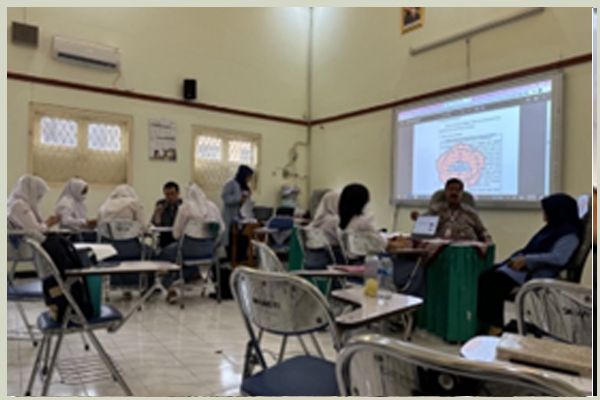
Experience with scientific discourse on student growth can inspire innovative assignments and promote applied learning for students. SMA N 6 Yogyakarta is a public school in Yogyakarta which has the motto The Research School Of Jogja. As a school that prioritizes excellence in the form of improving the quality of educational outcomes, SMA N 6 Yogyakarta continues to strive to improve quality, one of which is by assisting in writing scientific papers for its students and students, one of which is through mentoring in writing scientific papers for their students. The purpose of the service activities carried out is an understanding of the important points of scientific writing for class X students of SMA N 6 Yogyakarta. The method of implementing the service is lectures, discussions, and the practice of writing scientific articles. Implementation is divided into three stages, namely preparation, implementation and evaluation. The result of the devotional activity of accompanying the writing of scientific papers for students of SMA N 6 Yogyakarta is an increase in the knowledge of SMA N 6 Yogyakarta students about writing scientific papers, especially about how to research using methods properly and correctly. In addition, the devotional activity of accompanying the writing of scientific papers has also succeeded in being able to learn, test, measure, accurately regarding the direction of their research. Through this mentoring activity, it is a way of developing human resources that can build good social relations and also develop a good personality for students of SMA N 6 Yogyakarta as the young generation of Indonesia. Through this community service activity, the authors conclude that mentoring the writing of scientific papers for students at SMA N 6 Yogyakarta is very beneficial for consistently improving their research abilities because it enriches students' knowledge of comfortable scientific writing
Downloads
References
Anderson, C. B., Chang, S., Lee, H. Y., & Baldwin, C. D. (2020). Identifying Effective Mentors in Scientific Communication: A Latent Profile Analysis of Mentor Beliefs. Journal of Career Development, 49(2), 251–268. https://doi.org/10.1177/0894845320924127
Buijsrogge, A., de Boer, P.-T., & Scheinhardt, W. R. W. (2021). Importance sampling for Markovian tandem queues using subsolutions: exploring the possibilities. SIMULATION, 97(12), 849–866. https://doi.org/10.1177/00375497211041351
Daffern, T., Mackenzie, N. M., & Hemmings, B. (2017). Predictors of writing success: How important are spelling, grammar and punctuation? Australian Journal of Education, 61(1), 75–87. https://doi.org/10.1177/0004944116685319
De La Paz, S., Butler, C., Levin, D. M., & Felton, M. K. (2022). Effects of a Cognitive Apprenticeship on Transfer of Argumentative Writing in Middle School Science. Learning Disability Quarterly, 07319487221119365. https://doi.org/10.1177/07319487221119365
Halimah et al. (2022). The meaning of maintaining a life philosophy of simplicity for life pleasure: A study in Kampung Naga, Tasikmalaya. Journal of Human Behavior in the Social Environment. https://doi.org/https://doi.org/10.1080/10911359.2022.2128489
Hidayah, Y. (2020). Disertasi: PENGEMBANGAN MODEL BELAJAR KETERLIBATAN (MBK) UNTUK MEMPERKUAT PARTISIPASI POLITIK DAN CIVIC ENGAGEMENT WARGA NEGARA MUDA DI ERA DIGITAL (Diterbitkan). Bandung: Universitas Pendidikan Indonesia.
Hidayah, Y., Simatupang, E., & Belladonna, A. P. (2022). Pembudayaan Nilai-nilai Pancasila dalam Konsep Etika Ruang Digital di Era Post-Pandemi. Pancasila: Jurnal Keindonesiaan, 2(2).
Lin, V., Barrett, N. E., Liu, G.-Z., & Chen, H. H.-J. (2022). A Systematic Review on Inquiry-Based Writing Instruction in Tertiary Settings. Written Communication, 40(1), 238–281. https://doi.org/10.1177/07410883221129605
Reeves, C. A., & Ross, M. (2021). Writing Climate Change Assessments: Scientific Author Challenges and Rhetorical Negotiations. Journal of Technical Writing and Communication, 52(2), 182–212. https://doi.org/10.1177/0047281621989640
Riser, D. K., Clarke, S. D., & Stallworth, A. N. (2020). Scientific Memes: Using the Language of Social Media to Improve Scientific Literacy and Communication in Lifespan Development. Psychology Learning & Teaching, 19(3), 275–289. https://doi.org/10.1177/1475725720929277
Shpit, E. I., & McCarthy, P. M. (2022). Addressing discourse differences in the writing of Russian engineering students and international researchers. Language Teaching Research, 13621688221109808. https://doi.org/10.1177/13621688221109809
Downloads
Published
How to Cite
Issue
Section
License
Copyright (c) 2023 Yayuk Hidayah

This work is licensed under a Creative Commons Attribution-NonCommercial-ShareAlike 4.0 International License.